Your Backup Is Not A Strategy Until It Has Been Tested.
Most organizations discover their backup does not work the way they assumed at the exact moment they need it most. In a ransomware-defined threat landscape, attackers deliberately target backup credentials, backup schedules, and backup infrastructure instead of treating them as an afterthought. This whitepaper breaks down the five backup failures we find most often in mid-market environments, and it provides the framework for closing them before a real incident forces the question.
What's Inside the Whitepaper
The ransomware threat, updated.
Why modern ransomware operators deliberately target backup systems during a 21-day average dwell time inside the network and why an unisolated backup is the next target, not a recovery tool.
Failure 1: No tested restore procedure.
Why a backup that has never been restored is an assumption, not a data protection strategy.
Failure 2: Backup connected to the production network.
How a domain-admin compromise gives an attacker the same access to your backup as to everything else and what isolation actually requires.
Failure 3: No offsite or offline copy.
Why most mid-market organizations still don't meet the 3-2-1 baseline, and what that leaves exposed.
Failure 4: No backup for cloud workloads.
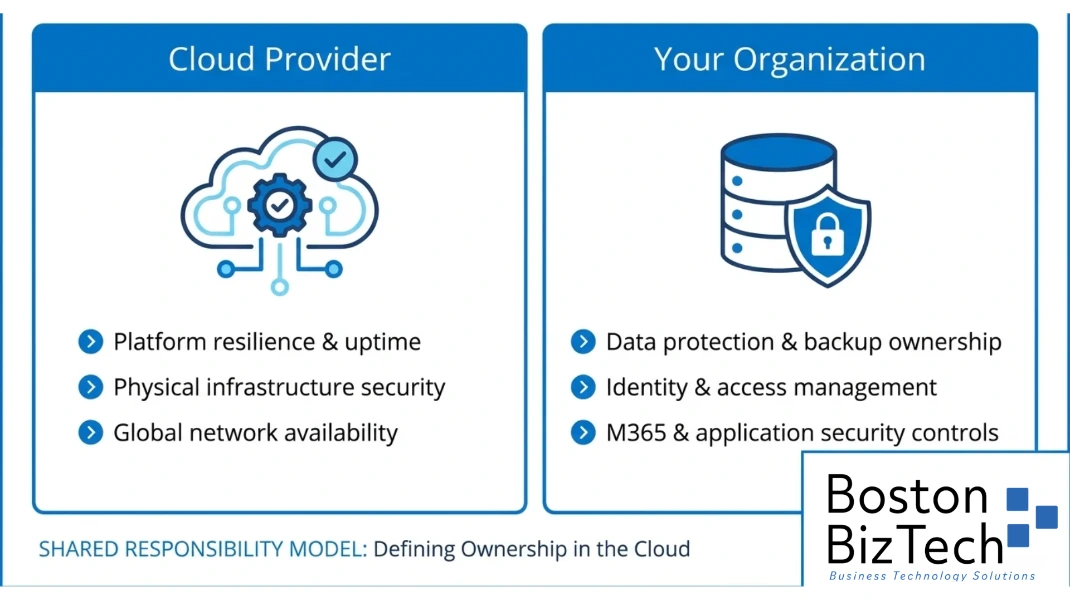
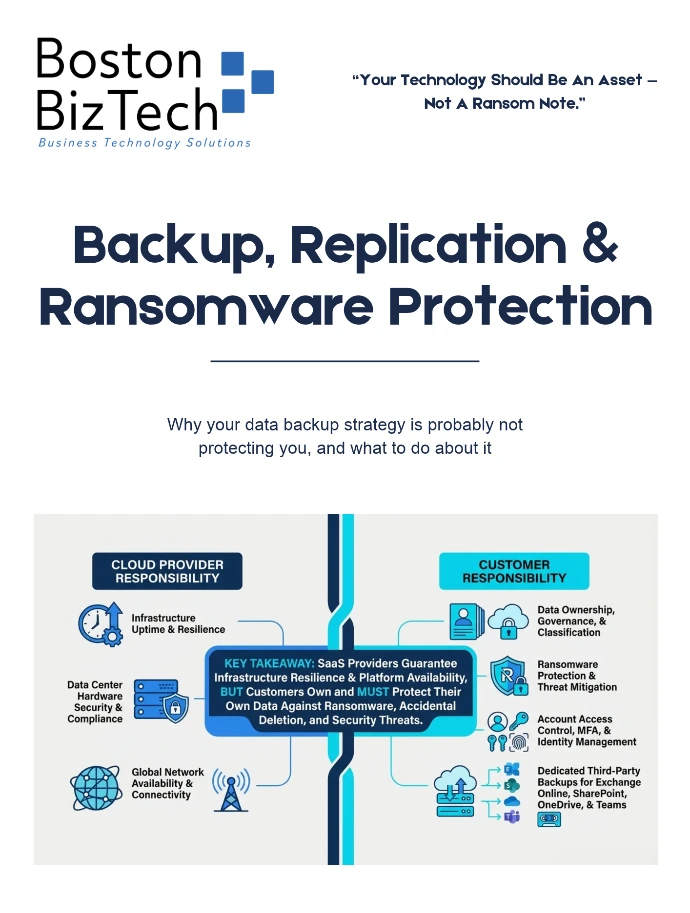
The Microsoft 365 assumption that costs organizations the most: Microsoft's infrastructure is resilient, but your Exchange, SharePoint, OneDrive, and Teams data is your responsibility to back up.
Failure 5: Backup without a recovery plan.
Why a copy of your data isn't the same as a documented, tested path back to operations, including a real case study on a clinical research company that ran two years with no functioning backup.
The 3-2-1-1-0 framework.
The updated standard for resilient data protection, including the immutability and zero-errors requirements that the original 3-2-1 rule didn't anticipate.
Who This Is For
Download the Whitepaper
BOSTON BIZTECH CASE STUDY
A clinical research company that Boston BizTech assessed had no functioning backup for two years. This vulnerability was discovered during a routine infrastructure assessment, not during a disaster. The organization was running its entire business, including clinical trial data, without any recovery capability. We rebuilt the backup architecture around the 3-2-1-1-0 framework, implemented immutable storage, and stood up a tested, documented recovery runbook. This intervention resulted in a documented restore time, a defensible position for FDA audit, and an exposure that no longer exists in plain sight.
WHEN DID YOU LAST TEST YOUR BACKUP RESTORE?
If you can't answer that with a specific date and a documented result, your backup strategy needs a review.
Schedule a free 30-minute discovery call. We will walk through exactly where your current backup approach would actually hold up and where it would fail before an attacker or an outage answers the question for you.
